一、漏洞概述
2024年10月9日,接安全厂商漏洞情报得知微软发布了10月安全更新,本次更新共修复了118个漏洞(不包括之前修复的3个Edge漏洞),漏洞类型包括特权提升漏洞、安全功能绕过漏洞、远程代码执行漏洞、信息泄露漏洞、拒绝服务漏洞和欺骗漏洞等。
本次安全更新中包括5个已经公开披露的0 day 漏洞,其中2个已发现被利用:
CVE-2024-43573:Windows MSHTML Platform 欺骗漏洞
Windows MSHTML 平台(该平台以前被 Internet Explorer 和旧版 Microsoft Edge 使用,其组件仍安装在 Windows中)存在跨站脚本漏洞,该漏洞的 CVSS 评分为 6.5。威胁者可诱使受害者点击特制链接或浏览恶意页面时触发该漏洞,从而可能导致恶意脚本在用户的浏览器中执行。目前该漏洞已经公开披露,且已检测到漏洞利用。
CVE-2024-43572:Microsoft Management Console 远程代码执行漏洞
Microsoft 管理控制台存在代码执行漏洞,该漏洞的 CVSS 评分为 7.8,威胁者可通过诱使受害者从网站下载并打开特制的 Microsoft Saved Console (MSC) 文件来利用该漏洞,成功利用可能导致任意代码执行。目前该漏洞已经公开披露,且已检测到漏洞利用。
CVE-2024-6197:Open Source Curl 远程代码执行漏洞
开源 Curl 中存在漏洞(该漏洞影响 curl、命令行工具和嵌入在各种软件中的 libcurl,由于 Windows 中附带 curl 命令行因此易受该漏洞影响),该漏洞的 CVSS 评分为 8.8,可能导致在 Curl 尝试连接到恶意服务器时执行命令。目前该漏洞已经公开披露,微软的可利用性评估为 “被利用的可能性较小”。
CVE-2024-20659:Windows Hyper-V 安全功能绕过漏洞
Windows Hyper-V 存在安全功能绕过漏洞,该漏洞的 CVSS 评分为 7.1,成功利用该漏洞需要用户重新启动其机器,在某些特定硬件上,成功利用该漏洞可能会绕过 UEFI,这可能导致虚拟机管理程序和安全内核被破坏。目前该漏洞已经公开披露,微软的可利用性评估为 “被利用的可能性较小”。
CVE-2024-43583:Winlogon 特权提升漏洞
Winlogon 存在特权提升漏洞,该漏洞的 CVSS 评分为 7.8,成功利用该漏洞可获得 Windows 中的 SYSTEM 权限。目前该漏洞已经公开披露,微软的可利用性评估为 “被利用的可能性较高”。
本次安全更新中修复的 3 个严重漏洞为:
CVE-2024-43468:Microsoft Configuration Manager 远程代码执行漏洞
Microsoft Configuration Manager 存在 SQL 注入漏洞,该漏洞的 CVSS 评分为 9.8,未经身份验证的威胁者可通过向目标环境发送恶意请求来利用该漏洞,这些请求以不安全的方式处理,从而可能导致在服务器或底层数据库上执行命令。微软的可利用性评估为 “被利用的可能性较小”。
CVE-2024-43488:Visual Studio Code extension for Arduino 远程代码执行漏洞
Visual Studio Code extension for Arduino 中缺少对关键功能的身份验证,该漏洞的 CVSS 评分为 8.8,可能导致未经身份验证的威胁者通过网络攻击导致远程代码执行。目前 Microsoft 已完全缓解该漏洞,受影响用户无需采取任何措施。微软的可利用性评估为 “被利用的可能性较小”。
CVE-2024-43582:Remote Desktop Protocol Server 远程代码执行漏洞
Remote Desktop Protocol Server 中存在 Use-After-Free 漏洞,该漏洞的 CVSS 评分为 8.1,未经身份验证的威胁者可通过向 RPC 主机发送格式错误的数据包,可能导致在服务器端以与 RPC 服务相同的权限执行远程代码,成功利用该漏洞需要赢得竞争条件。微软的可利用性评估为 “被利用的可能性较小”。
除 CVE-2024-43583 外,微软的可利用性评估中其他 “被利用的可能性较高”的漏洞还包括:
CVE-2024-43581/CVE-2024-43615:Microsoft OpenSSH for Windows 远程代码执行漏洞
Microsoft OpenSSH for Windows 中存在文件名或路径的外部控制,这些漏洞的 CVSS 评分均为 7.1,利用难度较高,需要受害者执行特定的文件管理操作来触发漏洞,成功利用可能在目标系统上导致远程代码执行。
CVE-2024-43502:Windows 内核特权提升漏洞
CVE-2024-43509:Windows Graphics Component 特权提升漏洞
CVE-2024-43556:Windows Graphics Component 特权提升漏洞
CVE-2024-43560:Microsoft Windows Storage Port Driver 特权提升漏洞
CVE-2024-43609:Microsoft Office 欺骗漏洞
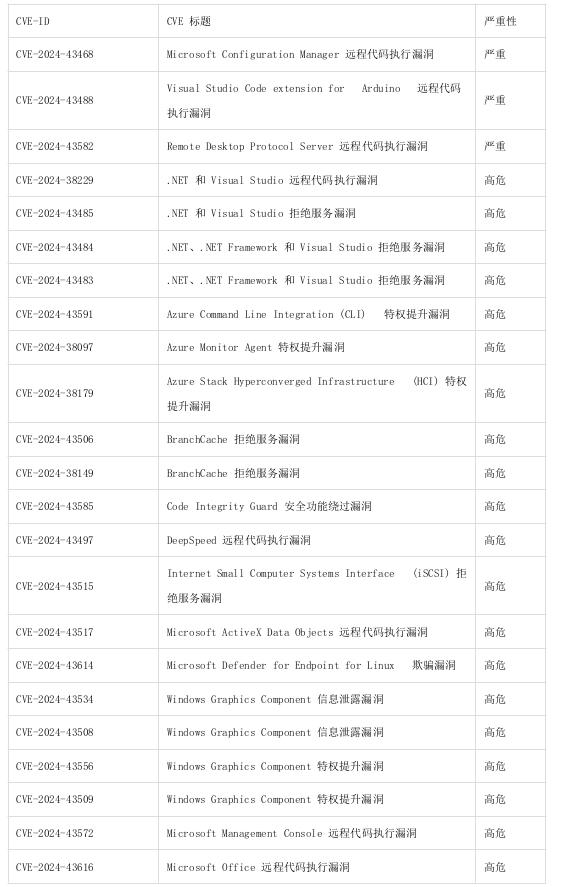
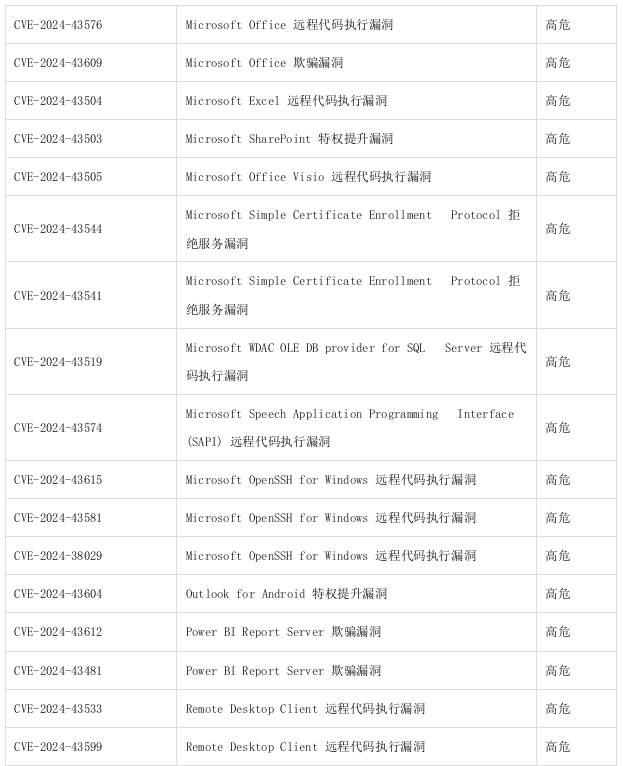
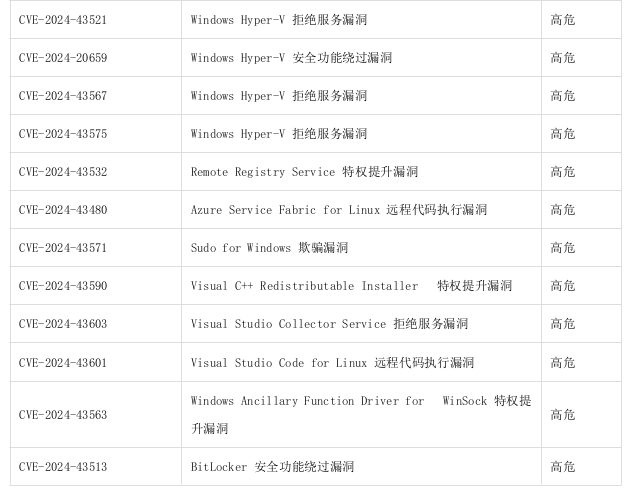
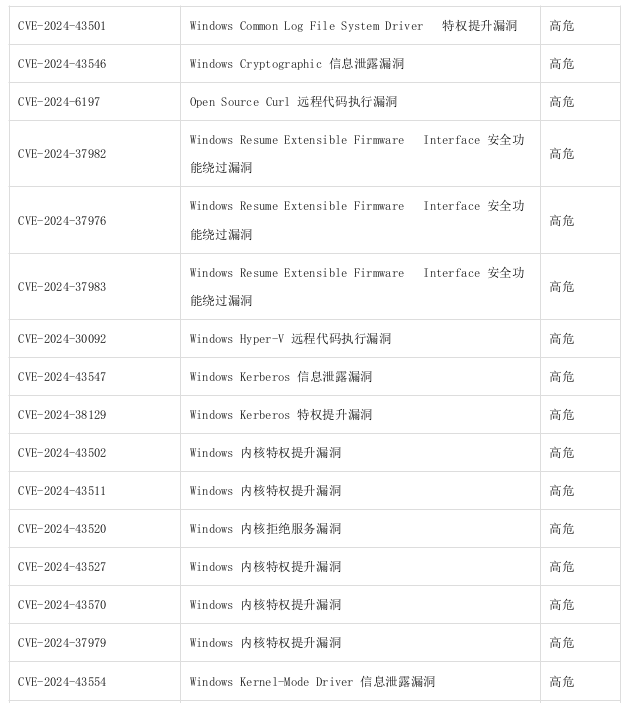
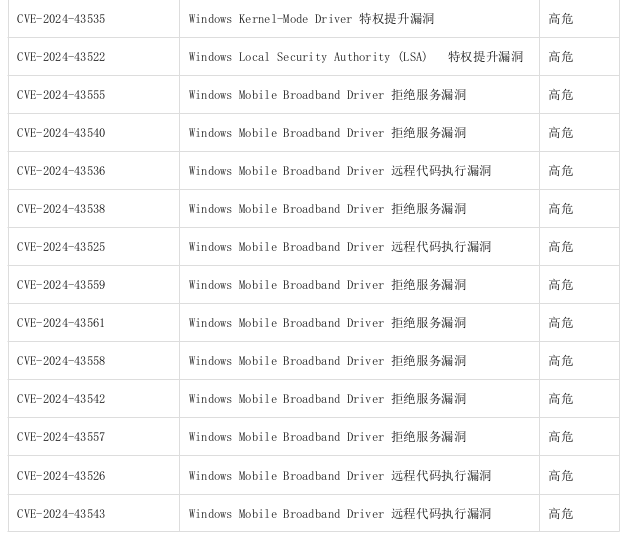
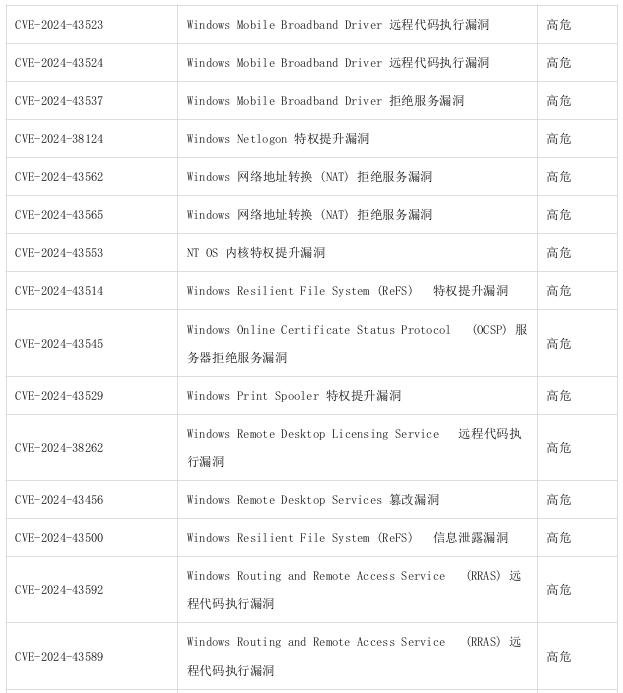
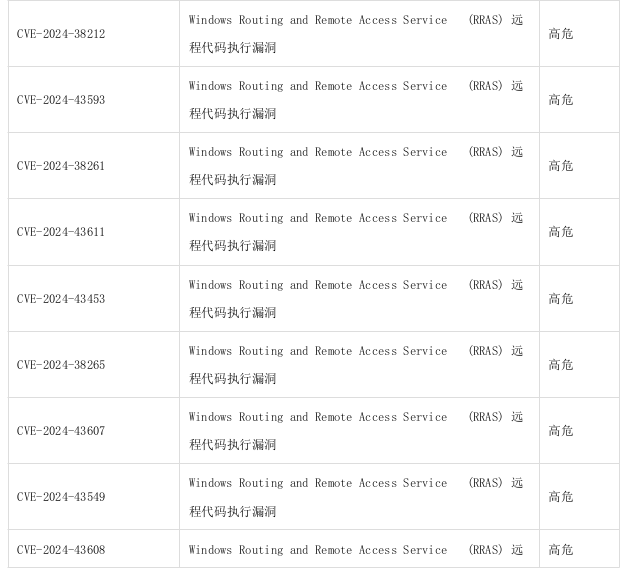
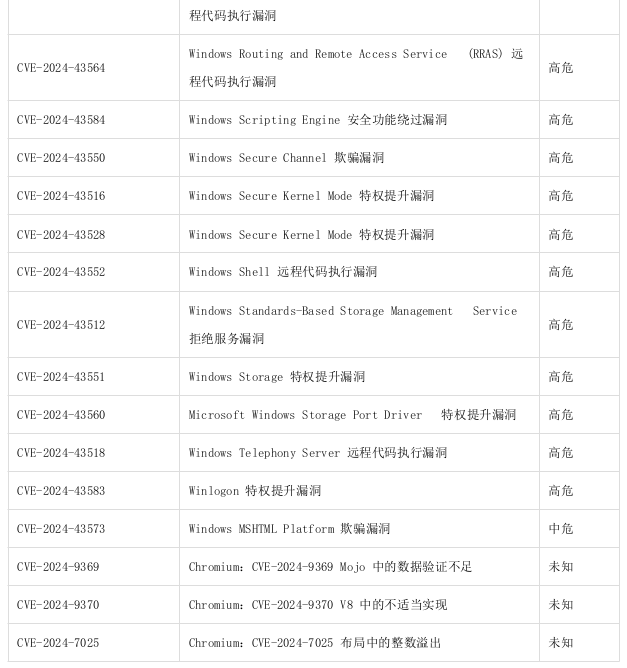
微软 10 月更新涉及的完整漏洞列表如下:
二、影响范围
受影 响的产 品/功能 /服务 /组件 包括:
Role: Windows Hyper-V
Windows Hyper-V
Windows EFI Partition
Windows Kernel
OpenSSH for Windows
Azure Monitor
Windows Netlogon
Windows Kerberos
BranchCache
Azure Stack
Windows Routing and Remote Access Service (RRAS)
.NET and Visual Studio
Windows Remote Desktop Licensing Service
Windows Remote Desktop Services
Microsoft Configuration Manager
Service Fabric
Power BI
.NET, .NET Framework, Visual Studio
Visual Studio Code
DeepSpeed
Windows Resilient File System (ReFS)
Windows Common Log File System Driver
Microsoft Office SharePoint
Microsoft Office Excel
Microsoft Office Visio
Microsoft Graphics Component
Windows Standards-Based Storage Management Service
Windows BitLocker
Windows NTFS
Internet Small Computer Systems Interface (iSCSI)
Windows Secure Kernel Mode
Microsoft ActiveX
Windows Telephony Server
Microsoft WDAC OLE DB provider for SQL
Windows Local Security Authority (LSA)
Windows Mobile Broadband
Windows Print Spooler Components
RPC Endpoint Mapper Service
Remote Desktop Client
Windows Kernel-Mode Drivers
Microsoft Simple Certificate Enrollment Protocol
Windows Online Certificate Status Protocol (OCSP)
Windows Cryptographic Services
Windows Secure Channel
Windows Storage
Windows Shell
Windows NT OS Kernel
Windows Storage Port Driver
Windows Network Address Translation (NAT)
Windows Ancillary Function Driver for WinSock
Sudo for Windows
Microsoft Management Console
Windows MSHTML Platform
Microsoft Windows Speech
Microsoft Office
Windows Remote Desktop
Winlogon
Windows Scripting
Code Integrity Guard
Visual C++ Redistributable Installer
Azure CLI
Visual StudioOutlook for Android
Microsoft Defender for Endpoint
三、安全措施
3.1 升级版本
目前微软已发布相关安全更新,建议受影响的用户尽快修复。
Windows Update 自动更新,Microsoft Update 默认启用,当系统检测到可用更新时,将会自动下载更新并在下一次启动时安装。也可选择通过以下步骤手动进行更新:
1、点击“开始菜单”或按 Windows 快捷键,点击进入“设置”
2、选择“更新和安全”,进入“Windows 更新”( Windows 8、Windows 8.1、Windows Server 2012 以及 Windows Server
2012 R2 可通过控制面板进入“Windows 更新”,具体步骤为“控制面板”->“系统和安全”->“Windows 更新”)
3、选择“检查更新”,等待系统自动检查并下载可用更新。
4、更新完成后重启计算机,可通过进入“Windows 更新”->“查看更新历史记录”查看是否成功安装了更新。对于没有成功安装的更新,可以点击该更新名称进入微软官方更新描述链接,点击最新的 SSU 名称并在新链接中点击“Microsoft 更新目录”,然后在新链接中选择适用于目标系统的补丁进行下载并安装。
3.2 通用建议
定期更新系统补丁,减少系统漏洞,提升服务器的安全性。
加强系统和网络的访问控制,修改防火墙策略,关闭非必要的应用端口或服务,减少将危险服务(如 SSH、RDP 等)暴露到公网,减少攻击面。
使用企业级安全产品,提升企业的网络安全性能。
加强系统用户和权限管理,启用多因素认证机制和最小权限原则,用户和软件权限应保持在最低限度。
启用强密码策略并设置为定期修改。
3.3 参考链接
https://msrc.microsoft.com/update-guide/releaseNote/2024-Oct
https://msrc.microsoft.com/update-guide/en-US/advisory/CVE-2024-43581

